A Straightforward Way to Handle What Alabama Asked of You

Meet Your Alabama Court Requirement From Anywhere

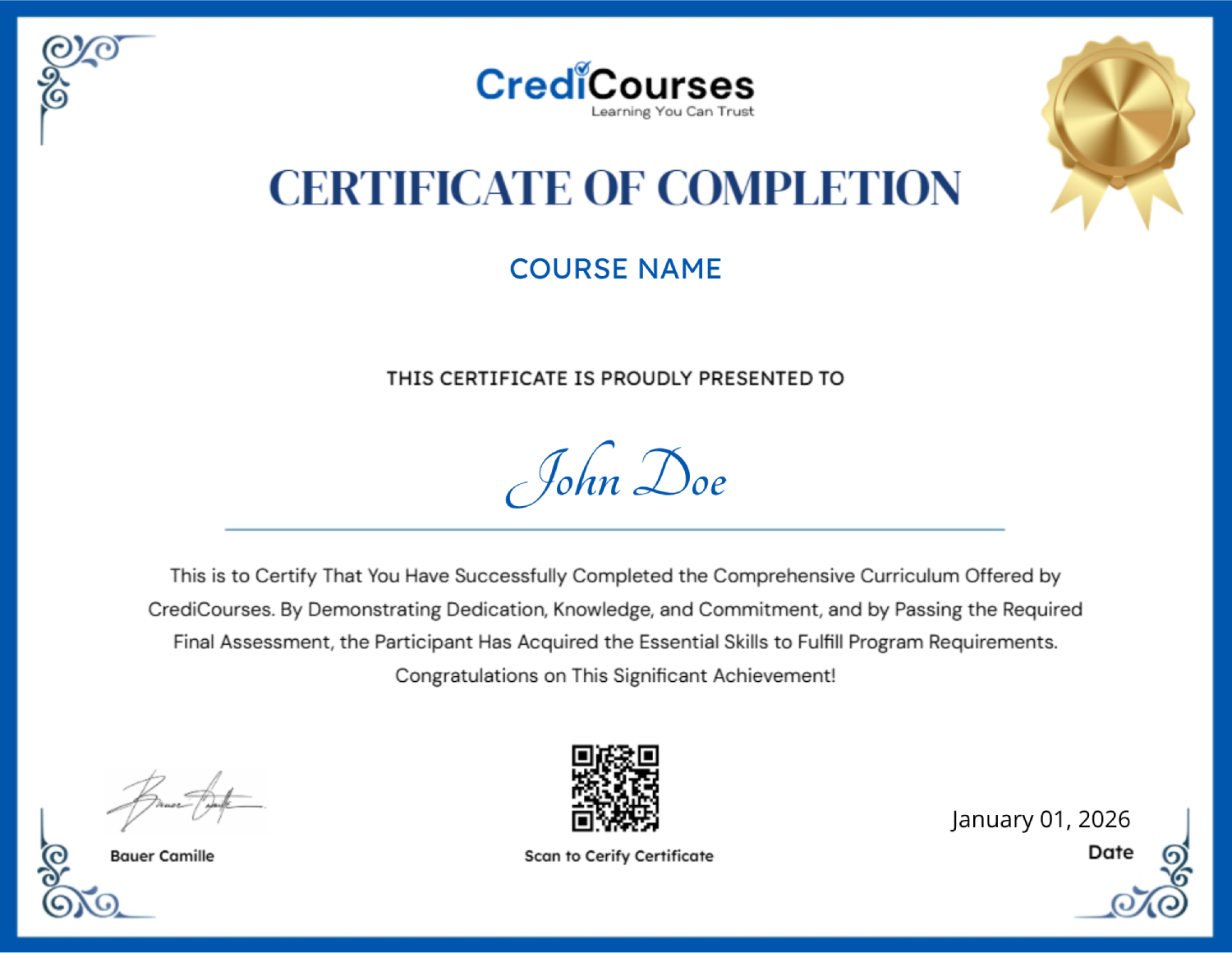
Getting summoned into a courtroom, a probation office, or a Court Referral Program appointment in Alabama already eats into a schedule most people can’t spare. CrediCourses cuts out the extra travel by keeping every lesson online: no dial-in codes, no attendance logs, no group calls to join at a set hour, and no ticking clock rushing you past material you haven’t absorbed yet. Log on whenever your day allows, between shifts at a Huntsville warehouse or after dinner in Mobile, using a phone, tablet, or laptop you already own. Finish the coursework and your Certificate of Completion is available immediately for your court, probation officer, or CRO.

Starts at:

$19 No Hidden Fees

acceptance Enroll Securely • Start Learning Instantly
Starts at

$19 - No Hidden Fees

Format

100% Online

Created By

Certified Experts

Certificate

Same Day

One Provider Trusted the Length of the State

Approved for Use in All 67 Alabama Counties

Autauga
Baldwin
Barbour
Bibb
Blount
Bullock
Butler
Calhoun
Chambers
Cherokee
Chilton
Choctaw
Clarke
Clay
Cleburne
Coffee
Colbert
Conecuh
Coosa
Covington
Crenshaw
Cullman
Dale
Dallas
DeKalb
Elmore
Escambia
Etowah
Fayette
Franklin
Geneva
Greene
Hale
Henry
Houston
Jackson
Jefferson
Lamar
Lauderdale
Lawrence
Lee
Limestone
Lowndes
Macon
Madison
Marengo
Marion
Marshall
Mobile
Monroe
Montgomery
Morgan
Perry
Pickens
Pike
Randolph
Russell
St. Clair
Shelby
Sumter
Talladega
Tallapoosa
Tuscaloosa
Walker
Washington
Wilcox
Winston

Nothing to Schedule, Nothing to Drive To

From Sign-Up to Certificate in Three Short Steps

Pick the course length assigned by your Alabama judge, Court Referral Officer, or attorney, create your login, complete the lessons at home, and print your certificate once you’re finished.

01

Choose Your Course

Browse our catalog to find the exact program you need to meet your court mandate, workplace requirement, or personal goal.

02

Enroll Instantly

Create your account and complete our secure checkout in minutes. There are no waiting periods—you get access to your materials right away.

03

Learn at Your Own Pace

Access your class 24/7 from any smartphone, tablet, or computer. Log in and out whenever it naturally fits into your busy schedule.

04

Pass the Assessment

Complete a straightforward final exam or quick knowledge checks to validate what you have learned and ensure you meet all compliance standards.

05

Download Your Certificate

The moment you pass, instantly access, save, and print your official, ready-to-submit proof of completion. No waiting on the mail.

Matched to the Order in Your Hand

Court-Ordered Course Options for Alabama Residents

From the Gulf Coast to the Tennessee Line

Alabamians Who Rely on CrediCourses

An Alabama circuit or district court judge ordered you to complete a class as part of your sentencing.
You're checking in with an Alabama Court Referral Officer and need documentation to close out your case file.
A conviction under Alabama's domestic violence statute (Ala. Code § 13A-6-130 through 132) came with a mandatory batterer intervention requirement.
You were convicted of DUI in Alabama and a Level 1 or Level 2 substance abuse program stands between you and license reinstatement.
Your Alabama custody or divorce case requires a parenting class before the judge will sign off on your agreement.
Your employer in Alabama asked for anger management or workplace conduct documentation after an internal incident.
You're completing a pretrial diversion agreement in an Alabama county and need an approved class on record.
A theft or shoplifting charge in Alabama carried a class requirement as part of your plea.
You're a parent working with the Alabama Department of Human Resources toward reunification.
An Alabama college's student conduct office referred you following a campus disciplinary matter.
You need documentation for an Alabama landlord, HR department, or licensing board after an unresolved dispute.
You're stationed at an Alabama military installation completing a program required by your command.
You want a recognized class addressing anger or decision-making before a situation turns into a legal one.
You need a class that satisfies a specific Alabama county's paperwork without missing a shift to attend it.
You're a co-parent in Alabama working through a required communication or parenting course.

Compare the Fine Print Before You Pay Anyone

How CrediCourses Stacks Up Against Other Alabama Options

Instead of paying inflated fees for in-person Alabama sessions with fixed schedules, weigh our transparent pricing, fully self-paced format, and acceptance guarantee before deciding where to enroll.

FeatureIn PersonLive ZoomGroup SessionsCrediCourses
24/7 Flexible Accesscrosscrosscrosstick
100% Private & Confidentialcrosscrosscrosstick
Completely Self-Pacedcrosscrosscrosstick
Zero Commute Requiredcrosscrosscrosstick
Zero Social Pressurecrosscrosscrosstick
No Webcam Requiredcrosscrosscrosstick
Works on Any Smartphonecrosscrosscrosstick

24/7 Flexible Access

In Person
Live Zoon
Group Sessions
CrediCourses

100% Private & Confidential

In Person
Live Zoon
Group Sessions
CrediCourses

Completely Self-Paced

In Person
Live Zoon
Group Sessions
CrediCourses

Zero Commute Required

In Person
Live Zoon
Group Sessions
CrediCourses

Zero Social Pressure

In Person
Live Zoon
Group Sessions
CrediCourses

No Webcam Required

In Person
Live Zoon
Group Sessions
CrediCourses

Works on Any Smartphone

In Person
Live Zoon
Group Sessions
CrediCourses

A Requirement Worth Taking Seriously, Not Just Surviving

What Actually Changes Once You Finish the Course

Landing in front of an Alabama judge is rarely part of anyone’s plan, and once it happens the goal usually shifts to getting through it with as little disruption as possible. Our courses are built around content you can actually use afterward: spotting your own triggers earlier, staying steady when a conversation gets heated, and choosing a different response before things escalate again. Rather than treating this as dead time before you can move on, think of it as the step that clears the runway toward a finalized custody arrangement, a reinstated license, or simply a closed file with your name off the docket.

Nationally Recognized

Our courses are built by professionals holding credentials through NAADAC, the National Anger Management Association, and the National Parenting Education Network, then checked against national education benchmarks. Alabama judges, Court Referral Officers, and defense attorneys are looking at qualifications they've already seen elsewhere in the state, not a name they need to look up.

Easily Accessible

There's no office to track down in Dothan, no parking lot to circle near a Montgomery courthouse, and no evening class competing with a second job. The course runs on whatever screen is nearest, so a poultry-plant worker in Cullman or a nurse in Tuscaloosa can finish identical material without begging anyone for time off.

Guaranteed Acceptance

We stand behind the certificates we issue, and rejection is rare, statistically around 0.50% of cases. If yours somehow lands in that small percentage, send over the court or agency's written denial and we'll refund your full enrollment, no argument, no runaround, no fine print working against you.

Why Alabama's Courts Keep Sending People Our Way

A Provider Alabama's Legal System Doesn't Have to Guess About

Alabama’s court system spans 67 counties and relies on a statewide network of Court Referral Programs staffed by certified officers who process DUI and substance-related cases every day. A provider working at that scale gets scrutinized constantly, not just glanced at once. CrediCourses curriculum follows the same accountability-driven, cognitive-behavioral framework behind Alabama’s batterer intervention standards and its tiered DUI education levels. Our instructors carry credentials through NAADAC, NAMA, and NPEN, so the certificate you submit isn’t an unfamiliar name to whoever opens your file, whether that’s in Birmingham or a smaller county courthouse.

Matched to CRO Standards

Alabama's Court Referral Program network relies on tiered, certified substance-abuse education, and our curriculum is structured to meet that same accountability-first model statewide.

Built Around State Law

Our approach reflects the same intent behind Alabama's domestic violence statute, Ala. Code § 13A-6-130 through 132, which ties intervention directly to behavioral accountability.

Recognized in Every Circuit

Whether your case sits in a Jefferson County courtroom or a rural circuit, our certificate format matches what Alabama's court system already processes routinely.

HRCI-Approved Documentation

Alabama employers and HR departments managing workplace conduct issues can rely on our HRCI-approved certificates the same way they'd trust in-person training.

Credentialed From the Ground Up

Every course is developed by NAADAC-affiliated instructors and specialists tied to the National Anger Management Association, matching the bar Alabama courts already expect.

The Same Standard Everywhere

From the Gulf Coast to the Appalachian foothills, the same coursework, the same credentials, and the same refund guarantee apply without exception.

What You're Actually Signing Up For

What Alabama Court-Ordered Classes Cover and Why They're Required

Alabama built its Court Referral Program back when the state noticed something simple: fines and jail time on their own weren’t changing what happened once someone got back behind the wheel, back into a relationship, or back into the same argument that started the case. So the state added a requirement to look at, coursework tied to the specific behavior involved, whether that’s substance use, anger, parenting conflict, or a domestic violence charge under Alabama’s own statute. A judge or Court Referral Officer assigns the subject and hours based on your actual paperwork, not a one-size template, and the material itself works through real triggers and decisions rather than lecture-hall theory. Show up with a completed certificate, and you’ve done more than check a box, you’ve handed the court documented proof that the behavior behind your case has actually been addressed, which tends to matter at whatever comes next, a hearing, a review, or a final ruling.

The Part Nobody Mentions Until It's Too Late

What Happens If an Alabama Class Requirement Doesn't Get Finished

Picture the paperwork sitting untouched for a few weeks past your deadline. Nothing dramatic happens right away, which is exactly the trap: your Court Referral Officer eventually logs the missed requirement, and that note becomes a delinquency report sent straight to the court, not a friendly nudge. From there, a judge can call you back in for a compliance hearing, and in some Alabama circuits, failing to explain yourself convincingly enough results in the same jail time your original sentence was designed to avoid. If your case involved a batterer intervention order, the stakes climb higher still, since Alabama ties that noncompliance directly to your original sentencing terms. Family court cases stall the same way: a judge waiting on a parenting class won’t finalize custody, and the other parent’s attorney will notice the gap. None of this requires a second offense, just an unfinished form. Closing it out, even late, is almost always easier than living with what’s still open.

The Evidence Behind Why Alabama Orders These Classes

What Alabama's Own Numbers Say About Court-Ordered Education

Alabama didn’t build its Court Referral Program network or its batterer intervention requirements on a guess, both reflect years of tracked outcomes on what actually reduces repeat offenses. The Alabama Department of Corrections and the state’s Reentry Task Force have published recidivism data for years, and the pattern consistently favors structured, supervised programming over incarceration with no behavioral component attached. Community-based corrections programs in particular have shown noticeably lower repeat-offense rates than standard prison release, part of why the state keeps investing in supervised alternatives. Domestic violence cases follow similar logic: Alabama law has treated the offense as its own category since 2000, requiring accountability-based intervention because education paired with consequences performs better than consequences alone. None of this is theoretical for the judge signing your paperwork, it’s the reasoning behind why completing an accredited class carries real weight instead of being just another form to file.

The Alabama Department of Corrections has reported a statewide three-year recidivism rate of roughly 28.7% to 31%, depending on the reporting year.
A 2007 ADOC study found 27.9% of adults released from Alabama prisons in 2003 were reincarcerated within three years of release.
Alabama's community corrections program completers showed a recidivism rate of 27.6% between 2014 and 2016, notably lower than the 38% rate for standard ADOC prison releases in the same period.
A broader Alabama Commission on the Evaluation of Services review of 2016 community corrections participants found an average 25.4% had reoffended three years later.
Only about 6% of Alabama parolees had their parole revoked for a new offense in a recent reporting year, one of the lowest recidivism figures in the state's system.
Alabama's Reentry Task Force, created through Reentry 2030, has set a goal of cutting the state's recidivism rate in half over the coming years.
As of a recent count, 36 community corrections programs were operating across 51 of Alabama's 67 counties.
Alabama's prison budget runs above $514 million a year, making corrections one of the state's costliest annual budget items.
The state spends roughly $23,360 per inmate annually, according to state budget and justice research data.
Alabama passed Act 00-266 in 2000, making it the 26th state to define domestic violence as its own criminal category with mandatory minimum sentencing for repeat offenders.
Under Alabama Code §§ 13A-6-130 through 132, a domestic violence conviction, even at the misdemeanor level, carries mandatory completion of a batterer intervention program.
Alabama's certified batterer intervention programs are required to meet a minimum standard of 16 weekly sessions under statewide program guidelines.
Alabama operates 29 individual Court Referral Programs statewide, each staffed by certified Court Referral Officers and juvenile instructors.
First-time Alabama DUI offenders are typically assigned a 12-hour Level 1 education program, while repeat or high-risk offenders may be assigned a 24-hour Level 2 program.
A first-time Alabama DUI conviction carries a mandatory minimum 90-day license suspension, with relief available only through a certified ignition interlock device.
Alabama law doubles DUI penalties automatically when a driver's BAC is 0.15% or higher, or when a child under 14 was in the vehicle at the time of arrest.
Alabama's incarceration rate stands at roughly 419 per 100,000 residents, placing it 17th nationally according to Bureau of Justice Assistance data.
State projections suggest Alabama's prison population could grow by as much as a third by 2030 without continued expansion of community-based and educational alternatives to incarceration.

Not a Harsher Sentence in Disguise

Why Alabama Judges Assign Classes Instead of Relying Only on Penalties

It’s easy to assume a class requirement is just one more thing stacked onto your case, but Alabama’s own approach points the other way. The state’s Court Referral Program network and its statutory batterer intervention requirements both reflect a deliberate choice to pair consequences with actual behavioral change rather than relying on fines or jail time by themselves. Judges lean on structured coursework because Alabama’s own recidivism data shows better long-term outcomes for people who complete supervised programming compared to those who don’t. The point isn’t to make your case harder than it has to be, it’s to stop a pattern before it turns into a second charge or a second victim.

Addressing the Underlying Behavior

Alabama pairs consequences with structured coursework because changing the thinking behind an offense holds up better long-term than punishment by itself.

A Standard Every Case Can Rely On

Certified programs give judges and referral officers a consistent tool to apply fairly instead of handling each case from scratch.

Accountability Without Public Shaming

These programs are designed to build skills and responsibility, not embarrass anyone, treating the requirement as growth instead of punishment.

Fewer Repeat Cases Down the Road

The real objective is preventing a second arrest or hearing, protecting your record, your family, and your future standing.

Trusted by Courts, Employers, and Learners Nationwide

Education you can rely on. Privacy you can count on.

This is a title

Frequently Asked Questions

Have questions about enrollment, course access, or your certificate? Browse our most common inquiries below to find everything you need to know before getting started.

Q. Will an Alabama court accept a CrediCourses certificate?
A. Yes. Our curriculum is developed by NAADAC-affiliated professionals and structured to match what Alabama judges, Court Referral Officers, and attorneys expect from an approved provider.
Q. Do I need to log into a live class session for my Alabama course?
A. No. The entire course is self-paced and online, no scheduled video sessions, no dial-in codes, and nothing you need to be present for at a set time.
Q. How long will my required Alabama course take?
A. That depends on what your judge, Court Referral Officer, or attorney assigned. The underlying material is consistent, only the length of the assessment portion changes to fit your required hours.
Q. What happens if my certificate isn't accepted?
A. This is uncommon, under 0.50% of cases. If it happens to you, send us the written denial and we'll refund your enrollment in full.
Q. Does my county affect whether I can enroll?
A. No. Our courses apply across all 67 Alabama counties, whether your case is being handled in a major circuit or a smaller county court.
Q. When can I download my Certificate of Completion?
A. As soon as you finish the coursework, ready to send to your court, Court Referral Officer, employer, or attorney.
Q. Is there a deadline forcing me to finish quickly?
A. There's no built-in timer pushing your pace. Log in on your own schedule and move through the material as quickly or gradually as you need.
Q. Who's actually behind the course content?
A. Instructors holding credentials through NAADAC, the National Anger Management Association, the National Parenting Education Network, and HRCI-approved standards developed every course we offer.
Q. Will my employer in Alabama accept this for a workplace issue?
A. Most Alabama employers and HR departments accept our certificates for workplace-related conduct or anger management matters, since our credentials meet recognized national standards.
Q. Does it matter if I'm not near a major Alabama city?
A. Not at all. Whether you're near Birmingham or in a small town along the Gulf Coast, the same online course and certificate apply.
Q. Do you offer courses for Alabama custody or family court requirements?
A. Yes. We offer parenting and co-parenting coursework commonly required in Alabama custody and family court cases.
Q. Does the price change depending on where in Alabama I live?
A. No. Pricing stays the same statewide, because your county shouldn't determine what a difficult legal situation costs you.
Q. Can my Court Referral Officer confirm my completion?
A. Yes. Your certificate includes verification details your Court Referral Officer, attorney, or the court can check if needed.
Q. What if the course length I need isn't listed?
A. Reach out to our support team and we'll help match you to the exact course duration your Alabama order requires.
Q. How private is my information once I enroll?
A. Completely private. Your enrollment and coursework stay confidential, visible only to you and whoever you choose to share your certificate with.