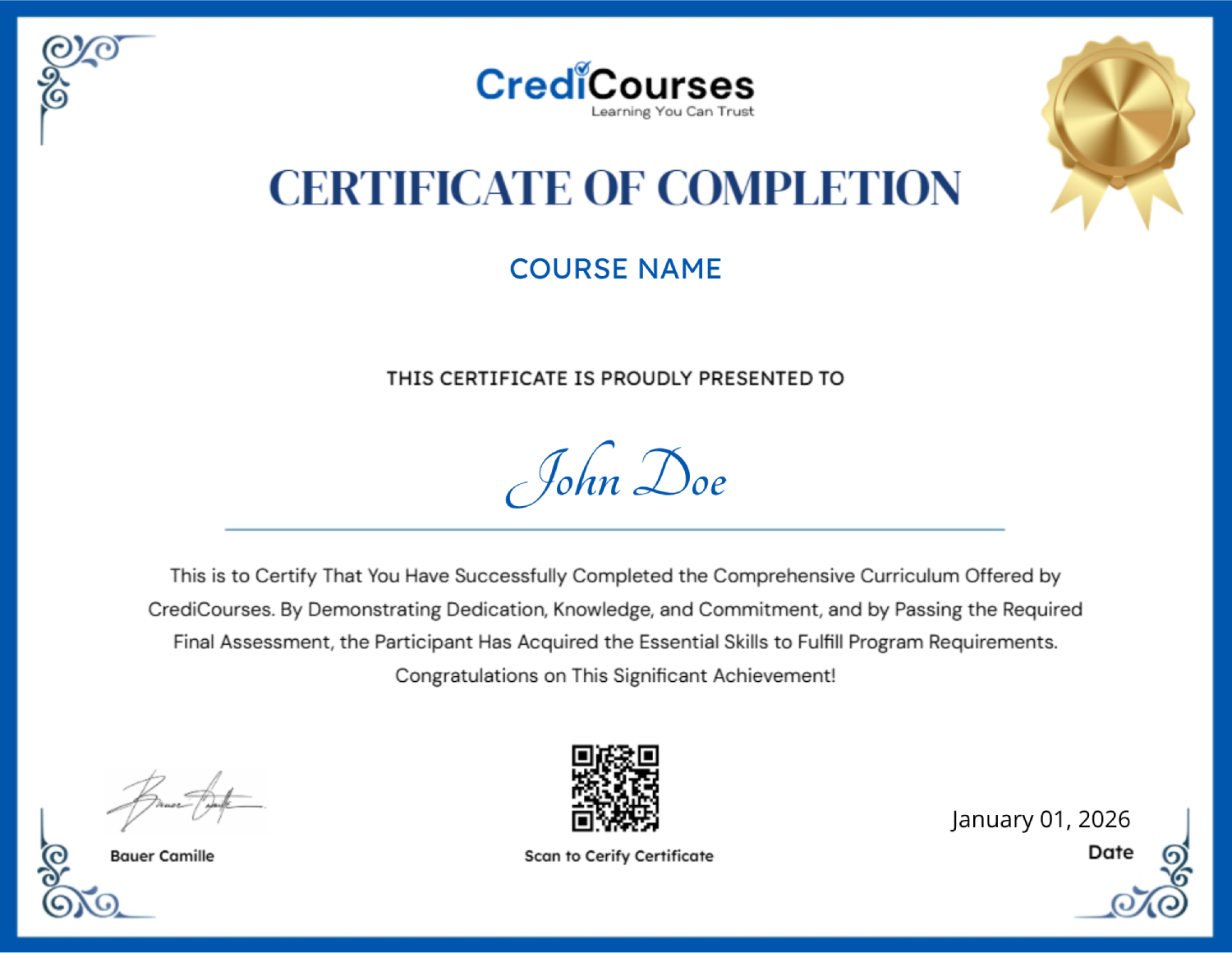
Court date behind you. Class requirement ahead. Now what? CrediCourses gives South Carolina residents a straightforward way to handle it: online, court-approved classes covering Anger Management, Alcohol & Drug Awareness, DUI/DWI, Parenting, Theft, Decision Making, Domestic Violence Education, and other requirements courts hand down across the state. Skip the Zoom calls. Skip the sign-in sheets. Skip the fixed class nights that never line up with your schedule. Everything happens on your phone or computer, at whatever hour actually works for you. Finish the material, and you’ll walk away with a Certificate of Completion your court, probation officer, or employer can verify without a phone call.
$19 No Hidden Fees
Enroll Securely • Start Learning Instantly
$19 - No Hidden Fees
100% Online
Certified Experts
Same Day
Register online, complete your course on whatever schedule fits, and download your certificate right after your last lesson. No mailing forms. No calling to book a seat.
01
02
03
04
05
Not every course provider charges fairly or teaches well. Compare CrediCourses against typical South Carolina providers on price, curriculum quality, court acceptance, and how much time it actually takes.
| Feature | In Person | Live Zoom | Group Sessions | CrediCourses |
|---|---|---|---|---|
| 24/7 Flexible Access | ||||
| 100% Private & Confidential | ||||
| Completely Self-Paced | ||||
| Zero Commute Required | ||||
| Zero Social Pressure | ||||
| No Webcam Required | ||||
| Works on Any Smartphone |
Nobody wants a court requirement sitting on their calendar. But treated right, this class can be more than an obligation to clear off the list. It’s a chance to understand what led to the charge in the first place, and to walk away with something useful instead of just a completed form. South Carolina residents who take this seriously tend to finish with real tools: better decision-making under pressure, a clearer read on their own triggers, a plan for handling the next hard moment differently. That’s the actual outcome we’re aiming for. Not a certificate for its own sake, but a person who’s genuinely better equipped than before.
CrediCourses curriculum meets national education standards, so South Carolina courts aren't reviewing something unfamiliar. Credentialed professionals built the material, and it's kept current with what courts expect from a completed course. That's why students across South Carolina, and across the country, keep choosing it year after year.
Whether you work third shift at a plant in Greenville or run a shop along Myrtle Beach's boardwalk, CrediCourses doesn't care what hours you keep. The course lives entirely online, so you log in when you're free, not when a classroom happens to be open. No commute, no missed shifts, no rearranging your week around someone else's schedule.
Court rejections on our certificates are rare enough that our team can recall nearly every case by name. If yours becomes one of them, send us the written denial letter from your court or probation officer, and we'll issue a full refund without pushback. We built that guarantee because we stand behind what we teach.
A lot of course providers make big claims and back them with very little. South Carolina residents dealing with a legal requirement deserve better than a guess about who’s actually reliable. CrediCourses was built around a simple standard: curriculum written by a certified team of experts, instructors who hold real credentials, and pricing that doesn’t punish people for being in a tough spot. Our refund guarantee isn’t a marketing line either — we honor it every time it applies. Given how seriously South Carolina courts treat alcohol and domestic violence education, we’ve made sure our material holds up to that scrutiny rather than cutting corners.
Every course comes from a certified team of instructors, not a generic template reused across every provider's site.
Our teaching staff holds credentials through NAADAC, NAMA, and NPEN — verifiable, not just claimed.
We keep costs low on purpose, because a court requirement shouldn't come with a markup attached.
Denials are rare, and when one happens, we process the refund quickly, without hoops to jump through.
Course content is reviewed regularly against what South Carolina courts and probation offices actually expect to see.
Thousands of South Carolina residents have submitted our certificates to courts and employers without a documented issue.
A court-ordered class is education a judge requires as part of a sentence, a probation condition, or a diversion agreement. In South Carolina, this most often follows a DUI charge, a domestic violence charge, or a theft offense, where the court believes structured education adds something jail time alone doesn’t. That belief carries extra weight here. South Carolina has tied for one of the highest rates of alcohol-impaired traffic deaths in the country, and its domestic violence numbers have ranked among the worst nationally for two decades running. Courts respond to that reality by leaning on education, not just punishment. CrediCourses builds its curriculum around what South Carolina judges, solicitors, and probation officers actually expect from a completed course. Finishing it isn’t just paperwork here. It’s often treated as a real signal that you engaged with the requirement, which can matter when your case comes up for review or sentencing.
A skipped court-ordered class in South Carolina doesn’t quietly disappear. A judge can issue a bench warrant, revoke probation, or add jail time for missing a sentencing condition. An employer who required a certificate as a condition of continued work can move forward without you. A family court matter involving custody can go sideways if a required parenting class stays unfinished. Even something as routine as reinstating a license after a DUI usually requires proof the class was completed first. These outcomes aren’t necessarily permanent — most can still be fixed once the requirement is met, even late. But every week it drags on tends to cost more, whether that’s added fines, extended probation, or a court that’s lost patience with the delay. Getting it done late still beats not getting it done at all.
South Carolina’s numbers on impaired driving and domestic violence are hard to look past. The state has tied for the highest share of alcohol-impaired traffic deaths in the country, and it has ranked in the top ten nationally for domestic violence homicides for more than twenty straight years. Courts here didn’t start ordering education classes as a formality. They did it because the data kept pointing to the same conclusion: punishment alone wasn’t changing outcomes fast enough. The figures below come from the South Carolina Department of Public Safety, the state’s domestic violence coalition, and published research on intervention programs. Reading through them explains why judges across the state keep attaching class requirements to sentences, and why finishing that requirement is treated as something more substantial than a signature on a form.
Judges in South Carolina don’t hand out class requirements to make a case heavier. They order them because education has a stronger track record than jail time alone at stopping the next incident. A class forces a real pause — time to sit with what happened and understand why, instead of moving straight from courtroom to daily life with nothing addressed in between. Courts here treat it as rehabilitation, not retribution, and that distinction matters. It’s also why completed coursework tends to carry weight later, whether at sentencing, a probation review, or a request to close out a case early.
South Carolina's own data links completed intervention programs to measurably fewer repeat DUI and domestic violence cases.
Judges often weigh finished coursework when deciding sentencing, probation terms, or requests to reduce a penalty.
Classes target the behavior behind the charge, something a fine or jail sentence rarely addresses directly.
Courts increasingly treat completion as a genuine indicator of future compliance, not just a formality.
Have questions about enrollment, course access, or your certificate? Browse our most common inquiries below to find everything you need to know before getting started.